
The Canberra Light Rail Stage 2A project is providing a practical example of how fly ash can be incorporated into major Australian infrastructure to help reduce the embodied carbon associated with concrete construction.
Extending Canberra’s light rail network south from the CBD to Commonwealth Park, Stage 2A forms part of the ACT’s ongoing investment in public transport infrastructure. Sustainability has been a key consideration for Canberra Metro Construction, with the project team targeting a 25% reduction in Scope 3 emissions.
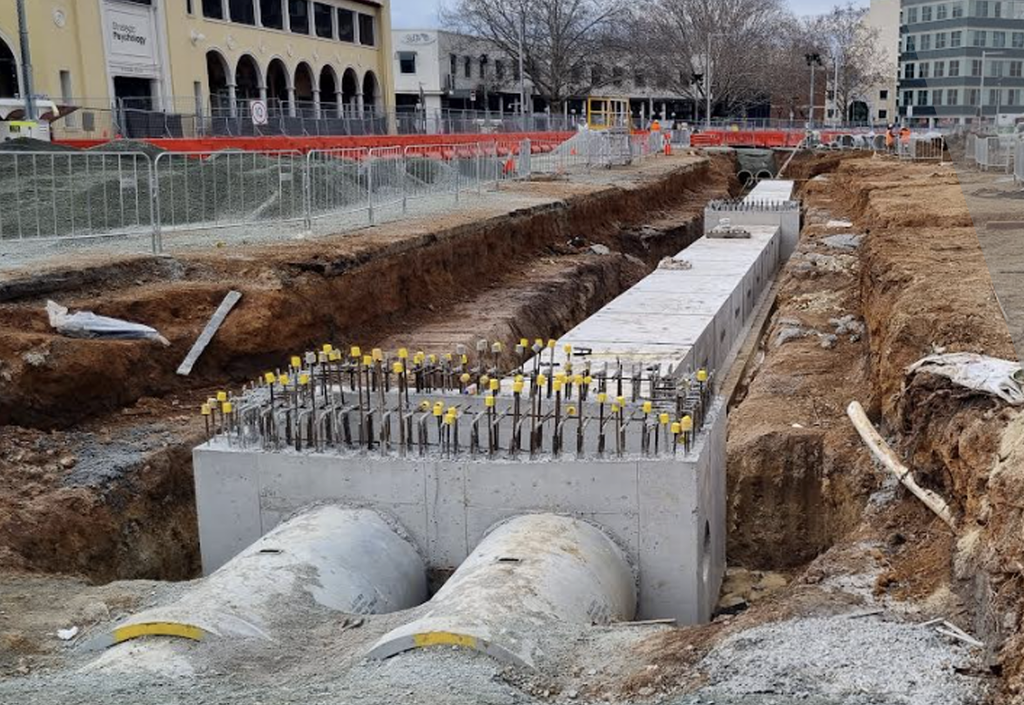
As part of this approach, Humes, a division of Holcim Australia, supplied precast concrete pipes and box culverts incorporating its FutureCast technology, which reduces the amount of Portland cement required through the use of supplementary cementitious materials (SCMs).
Importantly for the coal ash industry, fly ash was incorporated at significant replacement levels across both precast applications:
- Precast box culverts – 25% fly ash replacement
- Precast concrete pipes – 30% fly ash replacement
The use of fly ash demonstrates how coal combustion products can be beneficially utilised in major infrastructure while supporting efforts to reduce embodied carbon and maintain the performance requirements of precast concrete.
Turning Fly Ash into Infrastructure
The Canberra project highlights an increasingly important application for fly ash: replacing a proportion of Portland cement in concrete used for major infrastructure.
Rather than being treated simply as a residual material from coal-fired power generation, fly ash can be used as a supplementary cementitious material, providing an alternative input into concrete production while reducing the amount of Portland cement required.
For Canberra Light Rail Stage 2A, the material was incorporated into precast infrastructure that needed to meet the durability, strength and reliability requirements expected of a significant transport project.
According to the Humes case study, all precast products were designed, manufactured and tested under strict quality controls, with the fly ash-containing mixes delivering the required structural performance without compromising project delivery schedules.
Contributing to Lower Embodied Carbon
The use of fly ash formed part of a broader strategy to reduce the project’s environmental footprint.
Humes reports that the use of its FutureCast technology contributed to a 25% reduction in Scope 3 emissions across the precast components supplied to the project. This complemented other sustainability initiatives on site, including solar-powered compounds and the recycling of more than 95% of construction waste.
The outcome demonstrates the potential for established materials such as fly ash to contribute to the decarbonisation of construction without requiring a fundamental change to the types of infrastructure being delivered.
For large infrastructure projects involving significant quantities of concrete, reducing Portland cement content across individual components can contribute to broader project-level emissions targets.
A Practical Example of Coal Ash Utilisation
For the coal ash sector, Canberra Light Rail Stage 2A provides another tangible example of fly ash being put to productive use within Australia’s built environment.
In this instance, fly ash is not being used in a trial or demonstration product. It is incorporated at replacement levels of up to 30% in precast concrete products being installed as part of permanent transport infrastructure.
The project also demonstrates the opportunity for fly ash utilisation to align with changing procurement expectations as governments, contractors and infrastructure owners increasingly consider embodied carbon alongside traditional requirements such as strength, durability, cost and constructability.
Canberra Metro Sustainability Lead Mia Deans said the project represented an opportunity to establish new expectations around sustainability and set new standards for both the project and the ACT.
From By-product to Resource
Projects such as Canberra Light Rail Stage 2A reinforce the broader role coal combustion products can play within a circular economy.
The precast products supplied to the project contained 25% fly ash replacement in box culverts and 30% in concrete pipes, providing a clear example of an industrial material being incorporated into productive, long-life infrastructure.
As Australia’s construction sector continues to look for ways to reduce embodied carbon, applications such as these highlight an important opportunity for fly ash: reducing reliance on Portland cement while contributing to the delivery of the infrastructure Australian communities rely upon.
For the coal ash industry, Canberra Light Rail Stage 2A is a strong example of what beneficial utilisation looks like in practice — taking an existing material resource and putting it to work in the next generation of Australian infrastructure.
Source: Humes, “Canberra Light Rail Stage 2A – FutureCast Low-Carbon Solutions” case study.